
Casino odds can seem complicated, particularly when a game combines chance, rules, and different payout options. An odds calculator can make the numbers easier to understand, but it cannot predict a result or guarantee a profit; For UK players considering Kinghills Casino, its most useful role is as a planning aid: it can help explain possible returns, compare choices, and encourage sensible limits before play begins.
This review looks at what an online casino odds calculator can and cannot do, how to use one responsibly, and what to check before playing at Kinghills. Casino terms, payment options, and game availability can change, so confirm current details directly with the casino and read its rules before depositing.
What an Odds Calculator Actually Calculates
A calculator uses information about a game—such as the stake, probability of an outcome, and payout—to estimate a theoretical return. Depending on the tool, it may show the chance of a particular result, the expected value of a wager, or how much could be returned if a specified outcome occurs.
These calculations describe probabilities over many hypothetical rounds. They do not tell you what will happen in your next spin, hand, or roll. A slot result, for example, is not made more likely because a calculator shows that a particular combination has a low probability. Likewise, a streak of losses does not mean a win is “due.”
Odds, probability, and house edge
Probability is the likelihood of an event, usually expressed as a fraction or percentage. Odds may describe the relationship between the chance of an event happening and the chance of it not happening, or they may refer to a game’s payout terms. The house edge is the casino’s theoretical advantage over time, based on the rules and payouts.
For slots, the published return to player (RTP) is a long-term statistical figure, not a promise for an individual session. A 96% RTP, for instance, does not mean a player will get back exactly £96 from every £100 wagered. Actual results can differ substantially in the short term.
Using a Calculator Before Playing at Kinghills
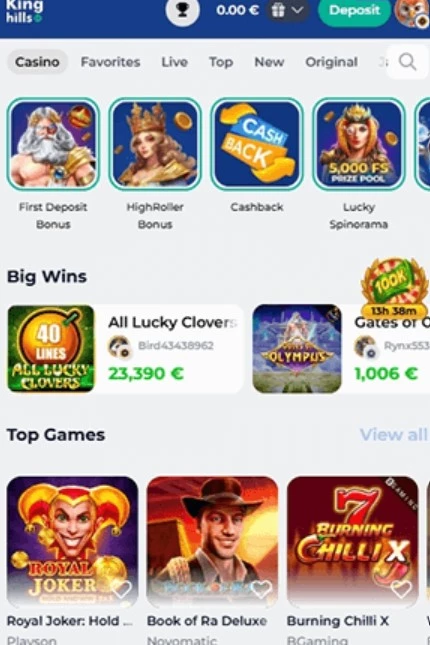
If you use a third-party odds calculator, first make sure its inputs match the specific game and bet you intend to play. Check that it accounts for the correct rules, paytable, and stake. An inaccurate or generic calculator can produce misleading estimates, especially for games with bonus rounds, side bets, or variable payouts.
- Choose a game and read its information. Look for the rules, paytable, RTP where available, and any special features.
- Set a fixed stake. Enter an amount you can afford to lose rather than an amount based on a desired win.
- Review what the result means. Treat the output as a theoretical estimate, not a forecast.
- Decide your limit in advance. Set a spending and time limit, and stop when either is reached.
- Check the casino’s current terms. Confirm eligibility, payment conditions, and any bonus restrictions before accepting an offer.
Kinghills Casino’s current games and features may vary by location and over time. Players in the UK should verify that the service is available to them and check the relevant licensing and consumer-protection information before registering. You can visit the casino at https://gb.ukkinghillscasino.com.
Can It Help You Make Better Decisions?
It can help when “better” means more informed, not more likely to win. A calculator may clarify why a high payout is paired with a low probability, or show how repeated wagers can add up. It can also make it easier to compare theoretical figures between games, provided the data is reliable and the games are being compared on a like-for-like basis.
It cannot identify a “hot” slot, reveal a future outcome, or turn a negative-expectation game into a dependable source of income. In games based on random outcomes, each round is generally independent. Previous results do not provide a dependable signal about the next one.
A simple expected-value example
Suppose a hypothetical wager costs £1. If it returns £5, including the original stake, when a certain event occurs with a 10% probability, and returns nothing otherwise, its average return across many identical wagers would be 50p per wager: 10% of £5. The theoretical expected loss would therefore be 50p per £1 wagered. This simplified example leaves out game-specific details, but it shows why a large possible payout does not automatically mean favourable odds.
Expected value is an average across a very large number of trials. It is not a description of what one player will receive in one session. A player could win more, win less, or lose the whole amount staked.
Benefits and Limitations
What it may help with
- Understanding probability, payout, and theoretical return.
- Seeing how stake size affects potential losses and returns.
- Comparing games when trustworthy, relevant data is available.
- Making a budget before play rather than deciding under pressure.
What it cannot do
- Predict random outcomes or guarantee a win.
- Replace the casino’s official game rules and paytable.
- Make a game profitable simply by choosing a different stake.
- Account perfectly for every bonus condition or changing game feature.
Be cautious of websites or tools that claim to forecast spins, provide a winning system, or promise a particular return. Such claims should not be treated as evidence. Use calculators for education and budgeting, not as a reason to wager more.
Responsible Play for UK Players
Before opening an account or depositing, check the operator’s current UK availability, licence details, age requirements, and terms. Never gamble if you are under 18. Review deposit and withdrawal rules carefully, and avoid playing with borrowed money or funds needed for bills and essentials.
Set limits that suit your circumstances and take breaks. If gambling stops feeling like entertainment or becomes difficult to control, stop and seek support. UK players can contact GamCare for confidential help through its current official channels. A calculator can support careful planning, but it is not a substitute for limits or professional assistance.
Frequently Asked Questions
Does an odds calculator predict a Kinghills slot result?
No. It can estimate theoretical probabilities or returns from supplied data, but it cannot know or predict the outcome of a future round.
Can a calculator show which Kinghills game pays best?
It may help compare published figures such as RTP, if those figures are accurate and refer to the exact game version. RTP alone does not measure the likelihood of a short-term win, and different game mechanics can make simple comparisons incomplete.
Is a higher RTP a guarantee of a better session?
No. RTP is a long-run theoretical measure; Individual sessions can vary widely, and a higher RTP does not guarantee that a player will win or recover a particular stake.
Should I increase my stake after a losing run?
No. A losing streak does not make a win more likely in the next independent round. Increasing stakes to recover losses can make them grow faster. Keep to a pre-set limit and stop when it is reached.
Is using an odds calculator safe?
The arithmetic itself is generally harmless, but be careful with unfamiliar websites. Avoid tools that ask for casino passwords, payment details, or unnecessary personal information, and do not install untrusted software. A calculator should never need access to your casino account to estimate basic probabilities.
Final Verdict
A casino odds calculator can be useful for UK players who want to understand probability, theoretical returns, and the cost of repeated wagering. For Kinghills Casino, it is best treated as an educational companion to the official game rules—not a prediction service or a winning strategy. Check the information behind every calculation, set firm limits, and remember that chance can produce results far from the theoretical average. If you choose to play, do so only for entertainment and within an amount you can afford to lose.
